Korean Air, Significant Potential for Profit Recovery in the Second Half
- Input
- 2025-07-11 16:09:20
- Updated
- 2025-07-11 16:09:20
Q2 Net Profit 395.9 Billion..13.4%↑
First Half Net Profit 15%↓..Passenger Maximum but Operating Cost Burden Remains
First Half Net Profit 15%↓..Passenger Maximum but Operating Cost Burden Remains
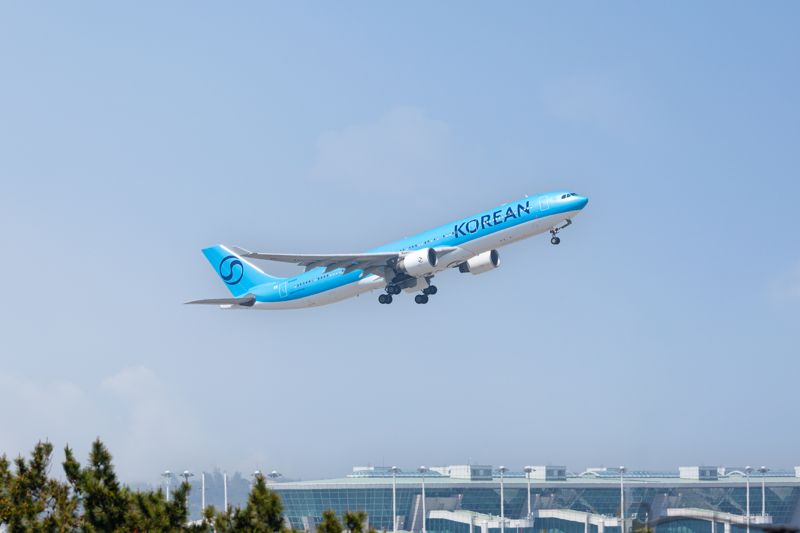
[Financial News] Korean Air is expected to have significant potential for profit recovery in the second half of this year. The passenger business in the third quarter is expected to show favorable results centered on major tourist routes due to increased demand following the entry into the summer peak season. Korean Air plans to maximize profits through flexible supply operations, such as expanding supply on demand-concentrated routes.
On the 11th, Korean Air announced through a disclosure that its net profit for the first half of this year on a separate basis was 589.1 billion won, a 15% decrease compared to 694.3 billion won in the same period last year. Operating profit during the same period was 749.9 billion won, a 12% decrease compared to 849.5 billion won in the same period last year. Sales during the same period increased by 1% to 7.9418 trillion won compared to 7.8462 trillion won in the same period last year.
In the second quarter alone, net profit increased by 13.4% to 395.9 billion won compared to 349.0 billion won in the same period last year. Operating profit decreased by 3.5% to 399.0 billion won compared to 413.4 billion won in the same period last year. Despite the reduction in fuel costs due to the decline in oil prices, operating costs such as labor costs and depreciation expenses increased.
Sales decreased by 0.9% to 3.9859 trillion won compared to 4.0237 trillion won in the same period last year. Amid ongoing concerns about economic slowdown due to intensified global trade conflicts, it was evaluated that efficient supply management helped to withstand the situation.
Second quarter passenger business sales recorded 2.3965 trillion won, a 2% decrease compared to the same period last year. The profitability indicators were similar to last year due to proactive responses to route-specific demand decreases due to seasonal off-peak effects and concentrated demand during the early May holidays.
Second quarter cargo business sales recorded 1.0554 trillion won, a 4% decrease compared to the same period last year. Although demand volatility expanded due to the announcement and postponement of mutual tariffs by the United States, it responded to market changes by diversifying its profit portfolio and attracting project-based demand such as semiconductors, batteries, and solar cells, as well as seasonal fresh cargo.
Korean Air plans to maintain stable profits in the third quarter cargo business by strengthening its ability to respond to market conditions and operating routes flexibly according to the results of tariff negotiations, despite the expected continuation of uncertainty in the U.S. tariff policy.
The number of international flight passengers at domestic airports in the first half of this year exceeded 46 million, recording an all-time high. The securities industry estimated the operating cost burden to be about 3.6072 trillion won. The securities industry projected Korean Air's annual consolidated sales this year to be 17.8871 trillion won and operating profit to be 2.1420 trillion won, an increase of 10.6% and 1.5%, respectively, compared to last year. This is due to the expectation of an expansion in premium demand for international flights as the possibility of a base rate cut and recovery in global consumer sentiment coincide. The integration with Asiana Airlines and the resulting route efficiency and optimal equipment operation are also expected to act as factors for performance improvement in the second half.
Choi Ji-woon, a researcher at Yuanta Securities, said, "As the average price of aviation fuel decreases, fuel costs are expected to decrease," adding, "However, due to the high exchange rate compared to last year, increased depreciation expenses due to the introduction of new equipment, and increased labor costs, the operating profit margin is expected to be 10.3%, similar to the same period last year."
He continued, "Although the profitability of LCC subsidiaries is expected to deteriorate due to intensified competition on short-haul routes, Korean Air's solid performance and Asiana Airlines are expected to turn a profit due to the effect of falling oil prices," adding, "Profitability is expected to improve significantly from the second half due to the effect of exchange rate stabilization."
ggg@fnnews.com Kang Gu-gwi Reporter