Households Earning 8 Million Won a Month Spend 662,000 Won on Private Education; Those Earning 3 Million Won Spend 192,000 Won
- Input
- 2026-03-12 12:00:00
- Updated
- 2026-03-12 12:00:00
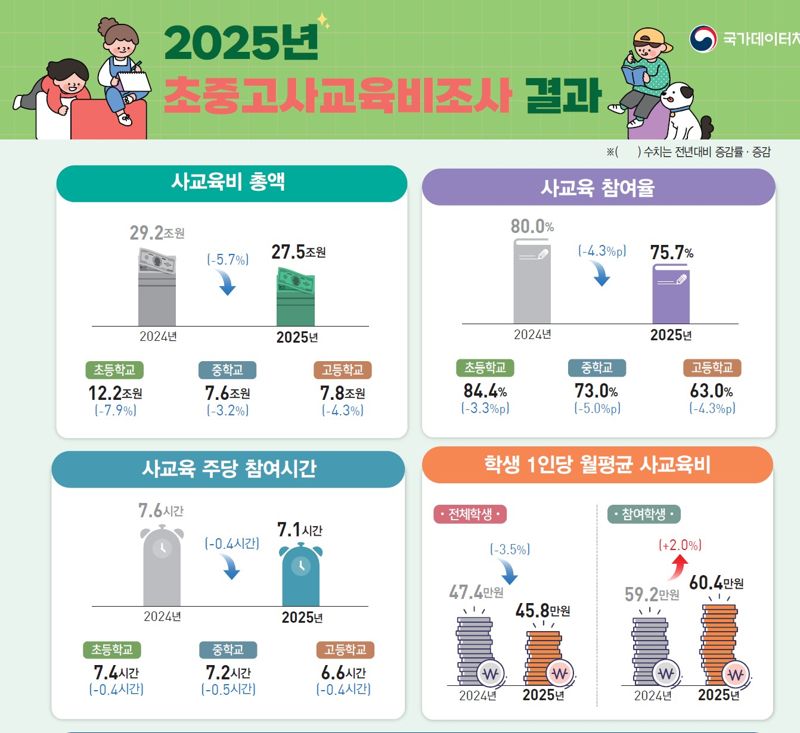
According to The Financial News, the average monthly private education spending per elementary, middle, and high school student last year was 604,000 won. In high-income households earning 8 million won or more per month, the amount was 662,000 won per student, while households earning less than 3 million won spent only 192,000 won. However, the total amount spent on private education turned to a decline for the first time since 2020. Analysts attributed the drop to a decrease in the number of students and weaker household consumption.
According to the Ministry of Data and Statistics report titled "2025 Survey on Private Education Expenses for Elementary, Middle, and High School Students" released on the 12th, total private education spending last year was 27.5 trillion won. This represents a decrease of 1.7 trillion won, or 5.7%, from the previous year. The average monthly private education spending per student, including those who did not receive private education, was 458,000 won, down 3.5% from 474,000 won a year earlier. In contrast, the average monthly spending among students who actually participated in private education was 604,000 won, up 2.0% from the previous year. In effect, the fees paid by students who do receive private education have continued to rise.
Ryu Chang-jin, Director of the Welfare Statistics Division at the Ministry of Data and Statistics, explained the decline in total private education spending by saying, "Overall, the number of students is on a downward trend," and added, "In addition, the private education participation rate itself (75.7%) fell by 4.3 percentage points from the previous year." He went on to say, "Spending on private education by students who do participate increased by 2.0% compared with the previous year, so the pace of growth slowed compared with 2024, when it was 7.2%." Regarding the increase in spending among participating students, he assessed that it "naturally rose due to factors such as inflation."
He also noted, "Rather than being driven mainly by income polarization, the overall participation rate in private education declined, so total private education spending per student fell. However, among students who do participate in private education, spending increased slightly across all income levels, regardless of income." He added, "That said, the scale of the increase was smaller than in 2024."
In reality, student participation in private education dropped compared with the previous year. Last year’s private education participation rate was 75.7%, down 4.3 percentage points year-on-year. Average weekly participation time was 7.1 hours, a decrease of 0.4 hours from the previous year. The Ministry of Data and Statistics cited the strengthening of public education as a key reason for the decline in private education participation. Participation in Neulbom School and after-school programs stood at 36.7%, the purchase rate of Korea Educational Broadcasting System (EBS) materials was 18.0%, and the rate of participation in overseas language training was 0.7%. These figures were similar to or slightly higher than the previous year.
However, the pattern of "educational polarization," in which higher-income households spend more on private education and show higher participation rates, remained unchanged. By monthly household income, average private education spending per student was 192,000 won for households earning less than 3 million won; 253,000 won for 3–4 million won; 336,000 won for 4–5 million won; 405,000 won for 5–6 million won; 530,000 won for 6–7 million won; and 662,000 won for 8 million won or more. The private education participation rate was 84.9% among households earning 8 million won or more, compared with 52.8% for those earning less than 3 million won. These figures were down 2.6 and 5.3 percentage points, respectively, from the previous year.
junjun@fnnews.com Choi Yong-jun Reporter